
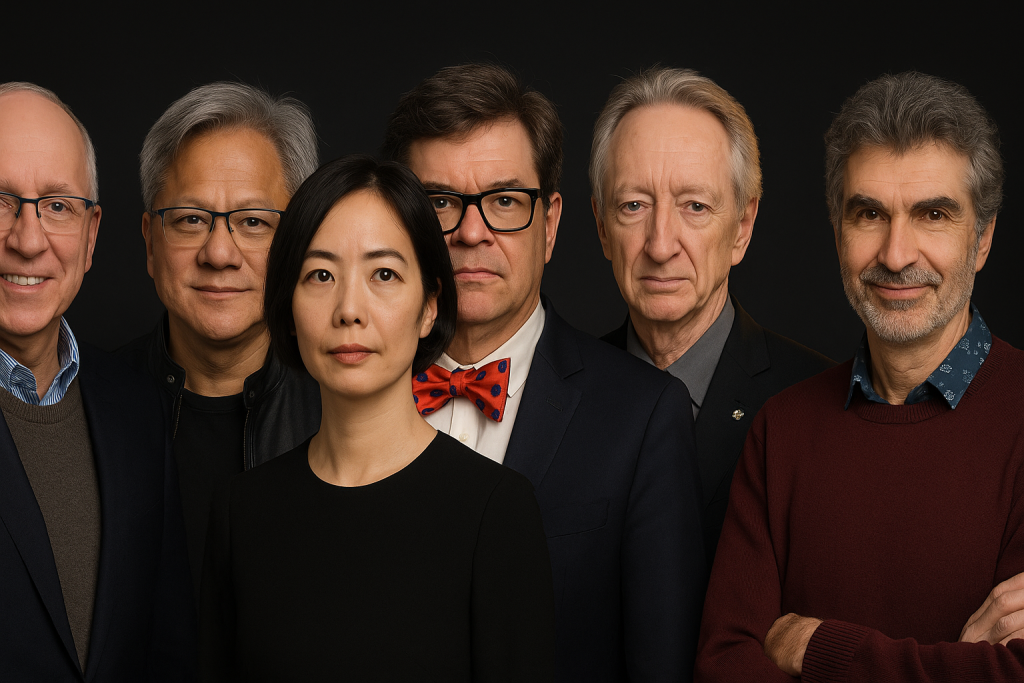
Six of the most brilliant minds in artificial intelligence, the very people who built the foundation for today’s technology, recently gathered for an exclusive conversation at the FT Future of AI Summit. These winners of the 2025 Queen Elizabeth Prize for Engineering discussed their decades of work, from early neural networks to the generative AI boom. Most importantly for us, they tackled the billion-dollar question everyone is thinking: Is this AI-driven market surge for real, or is it just another tech bubble waiting to burst?
Key Speakers
We heard from the pioneers who sparked the revolution, including Yoshua Bengio, Geoffrey Hinton, Fei-Fei Li, and Yann LeCun. We also heard from the builders creating the infrastructure that powers it all: Jensen Huang, CEO of Nvidia, and Bill Dally, Chief Scientist at Nvidia. Their combined perspective gives us a rare look under the hood of the AI economy.
The Key Takeaways
The conversation was a masterclass in the technology’s past, present, and future. Here are the top five takeaways you need to know.
1. Today’s “Overnight” Boom Was 40 Years in the Making
This isn’t a sudden fad. Geoffrey Hinton, often called the “Godfather of AI,” shared that he built a “tiny language model” back in 1984. He noted that the “basic principles were the same” as today’s massive models, but it took decades to get here. Why? As Hinton said, “we didn’t have the compute and we didn’t have the data.” This context is crucial: the current boom isn’t based on a brand-new, untested idea but on the long-term execution of a concept that finally has the data (thanks to pioneers like Fei-Fei Li’s ImageNet) and the processing power (thanks to GPUs) to work at scale.
2. This Isn’t a Repeat of the Dot-Com Bubble
When asked directly about a potential bubble, Jensen Huang gave the most powerful answer of the day. He drew a sharp distinction between now and the late ’90s. “During the dotcom era… the vast majority of the fiber deployed were dark,” he explained, meaning the infrastructure was built on pure speculation. “Today,” he contrasted, “almost every GPU you could find is lit up and used.” The takeaway is that the current demand for AI compute is not speculative; it’s being actively consumed by real-world applications, which suggests a far more stable foundation.
3. Think of AI as a New Kind of Factory, Not Just Software
This was Huang’s other key insight, and it’s a fundamental shift in thinking. Old software was “pre-compiled.” You built it once, and it ran. AI is different. As Huang put it, “intelligence has to be produced and generated in real time.” This means AI requires a new kind of industrial infrastructure. “We have created an an industry that requires factories,” he said. “We need hundreds of billions of dollars of these factories in order to serve the trillions of dollars of industries that sits on top of intelligence.” For investors, this reframes the entire opportunity: this isn’t just about software, it’s about building the global factories for a new commodity, intelligence itself.
4. Large Language Models (LLMs) Are Just the Beginning
While today’s boom is built on LLMs (like ChatGPT), the experts on stage were clear that this is just one piece of the puzzle. Yann LeCun argued that the current LLM-based approach is missing “something big” and won’t be the path to true human-level intelligence. Fei-Fei Li pointed to the next frontier: spatial intelligence. She noted that even today’s best models “fail at rudimentary spatial intelligence tests.” This suggests that while the language-based AI market is hot, the next massive waves of innovation and investment will likely come from AI that can understand and interact with the physical world think robotics, autonomous systems, and advanced sciences.
5. “Human-Level AI” Is Already Here (and It’s the Wrong Question)
The panel concluded by debating when we’d reach “Artificial General Intelligence” (AGI). The consensus? It’s the wrong way to look at it. Fei-Fei Li explained it perfectly: “Just like airplanes fly but they don’t fly like birds,” machine intelligence will be powerful but different from our own. In fact, it’s already superhuman in many ways. “How many adult humans can translate a 100 languages?” she asked. Bill Dally agreed, stating, “Our goal is not to build AI to replace humans… Our goal is to build AI to augment humans.” The value isn’t in some far-off “AGI” moment; it’s in the real applications being deployed today that augment human capability.
🏁 Conclusion
The final word from the architects of AI is clear: this is not a bubble built on “dark fiber.” The demand is real, the compute is being used, and the applications are just scratching the surface. While the market will certainly have its ups and downs, the foundational technological shift is undeniable. We are in the very early innings of building a new industrial-scale infrastructure for intelligence, and the pioneers who laid the groundwork 40 years ago are telling us the runway is still incredibly long.
For more of my insights on this topic, be sure to follow me.