
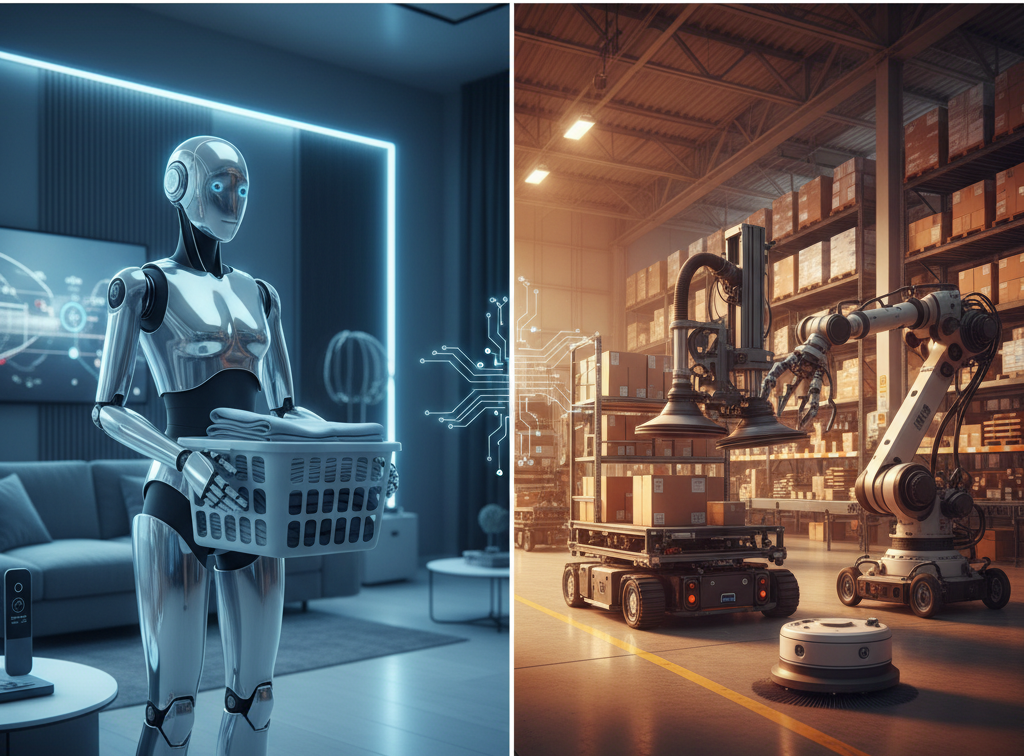
You’ve probably seen the videos: robots from companies like Tesla, Figure, and Agility Robotics that walk, talk, and handle objects. Billions of dollars are being invested, all chasing the dream of a “humanoid” robot that can work alongside us.
But behind the scenes, a major debate is raging in the tech world. It’s not about if we’ll have robots, but about the best way to build them. For an investor, understanding these two competing ideas is key to seeing the opportunities and risks.
Here’s a simple breakdown of the two main “teams” in the race for our robotic future.
Path 1: The “Do-It-All” Humanoid 🤖
This is the vision getting all the headlines.
-
The Idea: The world: our factories, homes, and offices were built for humans. Therefore, the most useful, versatile robot must also have a human shape: two legs, two arms, and hands.
-
The How: This approach relies heavily on artificial intelligence. The bet is that by training a massive AI model on videos of humans performing tasks, the robot can “learn” how to do everything from folding laundry to working on an assembly line.
-
The Big Bet: Companies like Tesla and Figure are betting that the “brain” (the AI) is the most important part. They believe that once the AI is smart enough, the hardware (like grippers and balance) can be perfected. The goal is one “general-purpose” robot that can do almost any physical job.
Path 2: The “Specialized” Worker ⚙️
This is the more skeptical, pragmatic approach, championed by robotics pioneers like Rodney Brooks (co-founder of iRobot, the company that makes the Roomba).
-
The Idea: Trying to build a “do-it-all” robot is a fantasy, at least for now. Brooks argues that human-like dexterity is impossible without a human-like sense of touch, something today’s robots almost completely lack.
-
The “Numb Hand” Problem: Brooks uses a simple example: Try unlocking your door with a key. Easy. Now, imagine your fingertips are completely numb. Suddenly, a simple task is incredibly difficult. He argues that today’s video-trained robots are like “numb hands”, they can see what to do, but can’t feel pressure, texture, or slip.
-
The Big Bet: This side believes the future is in specialized robots designed for specific jobs. They argue that wheels are far more efficient and stable than legs, and a specialized gripper or suction cup is better than a complex, fragile hand. Think of the Roomba (which only vacuums) or the robots in an Amazon warehouse (which only move shelves).
What This Means for Investors 🤔
As a retail investor, you don’t have to pick a winner today. You just need to understand the different bets you can make:
-
The “Moonshot” Bet (Path 1): Investing in the humanoid companies is a high-risk, high-reward “moonshot.” If they succeed in creating a general-purpose robot, they could become some of the largest companies in the world. The risk is that the technology is too difficult and the companies burn through their cash before solving it.
-
The “Utility” Bet (Path 2): Investing in companies that build specialized, “boring” robots is a different strategy. These robots are already working and profitable in logistics, manufacturing, and medicine. This is less of a “change the world” bet and more of an investment in a proven, growing industry.
The winner of this debate will define the next several decades of technology. Which approach do you think makes more sense?
Let me know your thoughts in the comments.
Follow me for more simple, smart investing strategy.
Join the Relax to Rich Club, where we grow wealth the calm, thoughtful way. ✨