
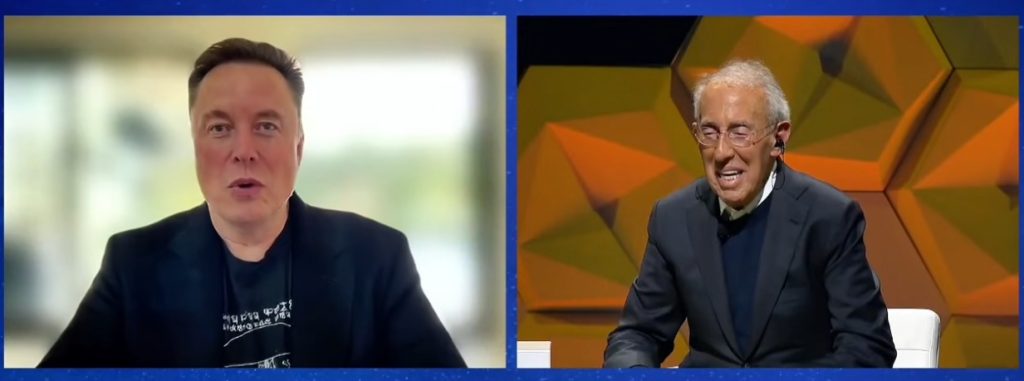
Today in a wide-ranging virtual chat with legendary investor Ron Baron, Elon Musk didn’t just talk about Tesla’s next quarter. He laid out a multi-decade vision that connects 5-second car manufacturing, humanoid robots, brain-computer interfaces, and the dawn of artificial general intelligence (AGI). It all centers on a new, overarching mission: achieving “sustainable abundance.”
Key Speakers
-
Host: Ron Baron, a celebrated value investor (Baron Funds) and a long-time, high-conviction Tesla bull. His perspective is focused on the long-term vision and the fundamental value being created across Musk’s companies.
-
Guest: Elon Musk, CEO of Tesla, SpaceX, and xAI. His viewpoint, as always, was from first principles, detailing the “why” and “how” behind his technological roadmap, from the physics of manufacturing to the moral imperative for AI.
The Key Takeaways
This wasn’t a typical earnings call. It was a deep dive into the philosophy that underpins the investment thesis. Here are the top five takeaways from their conversation.
1. The New Mission: “Sustainable Abundance”
Musk stated that Tesla’s original mission, to “accelerate sustainable energy”, is well underway. The new, revised goal is to achieve “sustainable abundance.”
What does that mean? In short, a future where robots and AI can produce any good or service you need. The key, he explained, is the Optimus robot. Musk doesn’t just see it as a factory worker; he envisions “billions of humanoid robots,” comparing it to a “personal helper buddy robot” that everyone will want.
This abundance extends to healthcare and housing. He spoke of robots building anyone a “castle if you want” and, more profoundly, providing universal access to elite medical care. “People often talk about eliminating poverty and providing great medical care, but they never… have a solution,” Musk said. “But now they… will get built in factories.”
2. The $60,000 “Six Million Dollar Man” is Coming
One of the most mind-bending moments came when Baron asked about helping a person in a wheelchair. Musk confirmed that a solution combining two of his companies is making real progress.
The plan is to use a Neuralink implant to read signals from the brain’s motor cortex and transmit them to an Optimus body or robotic legs. This would, in effect, create “superhuman cyborg capabilities.” Referencing the classic TV show, Musk noted, “We’re really getting like the $6 million man… but for much less than that… it might be well like $60,000 type of thing.” For investors, this highlights the incredible optionality and synergy between his seemingly separate ventures.
3. Why He Really Bought X (and Started xAI)
Baron suggested Musk bought X (formerly Twitter) for its valuable data, but Musk corrected the record. The acquisition, he said, was ideological. He felt the platform was having a “negative effect on civilization” and that it was vital to restore a “public square” for “true freedom of speech,” which he repeatedly called the “bedrock of democracy.”
Similarly, his new company, xAI, was born from a moral imperative. He explained he co-founded OpenAI years ago to be a nonprofit “counterbalance to Google,” fearing its leadership wasn’t on “team humanity.” He left when it became a for-profit entity, which he felt wasn’t “morally or legally transible.” For investors, this context is crucial: xAI isn’t just another AI play; it’s Musk’s attempt to build an AI he believes will be pro-human.
4. The 5-Second Car (and Why No One Else Can Do It)
For investors focused on Tesla’s core auto business, the most important details were about manufacturing. Musk confirmed he sees a clear path to a 5-second cycle time, meaning a new car rolling off the assembly line every five seconds.
He achieves this by applying “the tools of physics” to the factory, thinking of it as a 3D “chip” and maximizing “volumetric density.” When Baron asked why competitors don’t just copy this, Musk’s answer was blunt: “Most companies are incrementalist.” He explained that traditional management teams are afraid to “take big risks that could fail” and would rather aim for a 5-10% improvement. This “first principles” approach to manufacturing is Tesla’s deepest competitive moat.
5. Grok 5, AGI, and the Hardware Advantage
The AI discussion went far beyond self-driving. Musk announced that Grok 5, his next-gen AI model, is coming in Q1 and said it’s the first time he believes there is a “10% chance of achieving artificial general intelligence.”
He outlined xAI’s three key advantages: talent, unique real-time data from X, and, most critically, hardware. This hardware advantage connects directly back to Tesla. He is personally managing the development of the AI5 chip, an essential component for both Optimus and the next level of Full Self-Driving (which he says is already “four times safer” than a human).
Frustrated with the 5-year timeline from partners like TSMC, Musk is now openly considering having Tesla “build up a really big fab” itself. This drive for vertical integration, from the chip to the data center to the AI model, is the engine for the “sustainable abundance” he plans to build.
🚀 The Big Picture
Musk’s final message was one of purpose. He’s “unabashedly pro-human” and his ultimate goal is to “expand consciousness into the future” and “understand the universe.” For investors, the takeaway is clear: you’re not just betting on a car company. You’re betting on a vertically integrated engineering machine, tackling robotics, AI, and manufacturing from the ground up, all driven by a singular, audacious vision.
For more of my insights on this topic, be sure to follow me.